Urban Forests as the Earth's Lungs: Carbon Absorption in Cities
Urban forest carbon absorption explained: how much a hectare takes up, what affects it, plus benefits and challenges, with examples from Jakarta and Seoul.

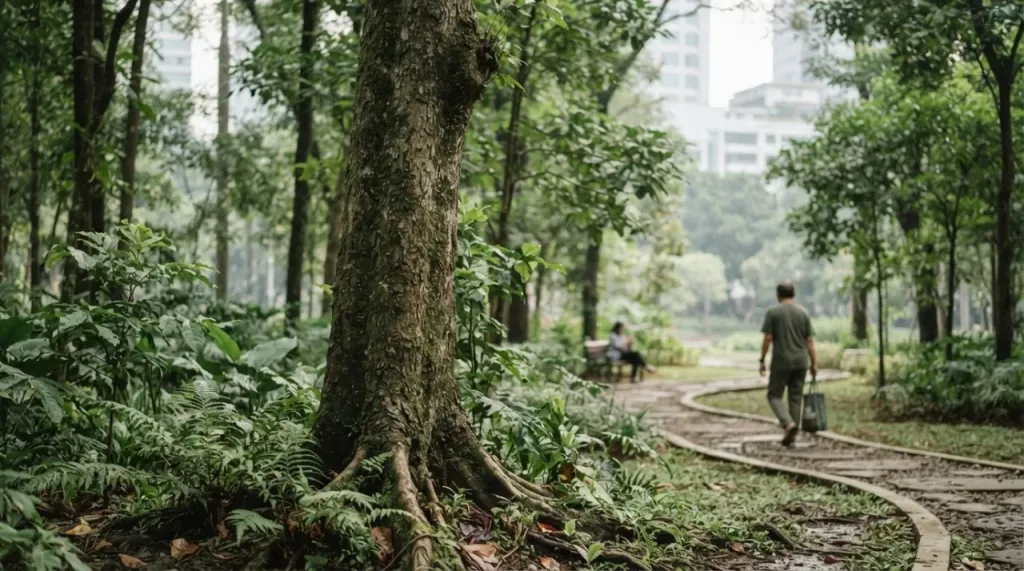
In the middle of a city that never sleeps, an urban forest is a natural oasis that does more than rest the eyes. It also plays an important part in cutting carbon emissions. With concrete and asphalt dominating the urban landscape, green space becomes the last line of defense for air quality and the microclimate, and for absorbing the carbon dioxide produced by human activity. But how effective are urban forests at absorbing carbon, really, and why is their presence becoming more urgent?
The Strategic Role of Urban Forests in the Urban Environment
An urban forest is more than a big park in the middle of a city. It is a complex ecological system of trees, shrubs, soil, and other living things that interact with one another. Its main functions go beyond looks or recreation: it regulates air quality, stores rainwater, filters pollution, and provides habitat for wildlife.
When it comes to carbon emissions, the trees in an urban forest act as carbon sinks. They take CO₂ from the atmosphere through photosynthesis, store it as biomass, and release oxygen into the air. That makes urban forests a vital element in climate change mitigation in dense, busy urban environments.
How Effective Are Urban Forests at Absorbing Carbon?
According to research from the Center for International Forestry Research (CIFOR), one hectare (about 2.5 acres) of densely vegetated urban forest can absorb roughly 20 to 50 metric tons of carbon per year, depending on the tree species, age, and planting density. That is far lower than natural tropical forest, which can absorb up to 200 metric tons per hectare per year, but it is still significant at the scale of a city.
A study in Jakarta by Indonesia's National Research and Innovation Agency (BRIN) found that Tebet Eco Park, which covers about 7 hectares, can absorb more than 35 metric tons of CO₂ per year. That figure shows that well-managed green space makes a real contribution to cutting carbon emissions in a city.
Factors That Affect Carbon Absorption in Urban Forests
Carbon absorption in urban areas depends not only on the size of the land but on several other variables:
-
Tree Species and Density
Broad-leaved, fast-growing trees such as rain tree (trembesi), angsana, or mahogany are known for their high carbon absorption capacity. The denser and more varied the trees, the greater the carbon absorption. -
Tree Age and Condition
Trees in an active growth phase (usually 10 to 30 years old) absorb more carbon than old trees whose growth has slowed. -
Soil and Environmental Conditions
Fertile soil with enough moisture supports root growth and the activity of microorganisms, which also help store carbon in the soil (soil carbon sequestration). -
Management and Maintenance
An urban forest that is well cared for, with a drainage system, natural fertilization, and protection from pollution, will be more productive than one that is neglected.
Additional Benefits of Urban Forests
Besides absorbing carbon, urban forests have other positive effects that support environmental sustainability:
-
Lowering City Temperatures (Urban Heat Island Effect)
Urban areas tend to be hotter than their surroundings because hard surfaces dominate and absorb heat. Urban forests help lower temperatures through evaporation and shade. -
Reducing Air Pollution
Leaves and trunks capture dust particles, sulfur dioxide, nitrogen oxides, and other pollutants from the air. A study by the EPA in the US found that urban trees can significantly reduce PM10 concentrations. -
Managing Rainwater and Floods
Tree roots and vegetation absorb rainwater and reduce surface runoff. This matters for flood-prone cities such as Jakarta, Medan, or Surabaya. -
Improving Public Health and Well-Being
Green space has been shown to lower stress, increase physical activity, and support healthy social interaction.
Challenges in Developing Urban Forests
Unfortunately, developing urban forests is not always easy. The main challenges include:
-
Limited Land
Rapid city growth often comes at the expense of green space. Vacant land is more often allocated to commercial development than to public space. -
Lack of Public Awareness and Participation
Many residents do not yet understand why urban forests matter, so they often damage facilities or fail to keep the area clean. -
Weak Regulation and Funding
Some regions do not yet have adequate rules on allocating and preserving green space. On the other hand, budgets for maintaining urban forests are often limited.
Initiatives and Hopes for the Future
Cities around the world have shown success in making urban forests part of their sustainability strategies. Seoul in South Korea, for example, has more than 2,000 connected city parks covering more than 27% of the city. Singapore, meanwhile, has made itself a “City in a Garden” with a consistent tree-planting strategy.
In Indonesia, cities such as Bandung and Surabaya are starting to take open green space seriously. Programs such as tree planting by residents, community parks, and urban gardens are a positive first step. Looking ahead, technologies such as air quality monitoring, soil moisture sensors, and vegetation-mapping drones can help manage urban forests more efficiently.
Closing With a Metaphor
You could say an urban forest is “a fresh breath in the middle of a civilization struggling to breathe,” a metaphor for how much green space matters under the pressure of urbanization and ever-worsening pollution. It is not just natural decoration but a living system that sustains the city.
Calling on Residents and Stakeholders to Take Part
Every party, whether individuals, communities, the private sector, or government, needs to start taking part in protecting and expanding green space. Planting trees is no longer just a symbolic act. It is a real investment in the future of the planet and the generations that follow.
If you belong to an agency, company, or community that wants to measure its environmental contribution, design a green space project, or calculate and reduce carbon emissions in an urban setting, don't hesitate to contact Mutu International. As a trusted sustainability certification and verification body, Mutu is ready to be your partner in building a greener, healthier, climate-friendly city.